
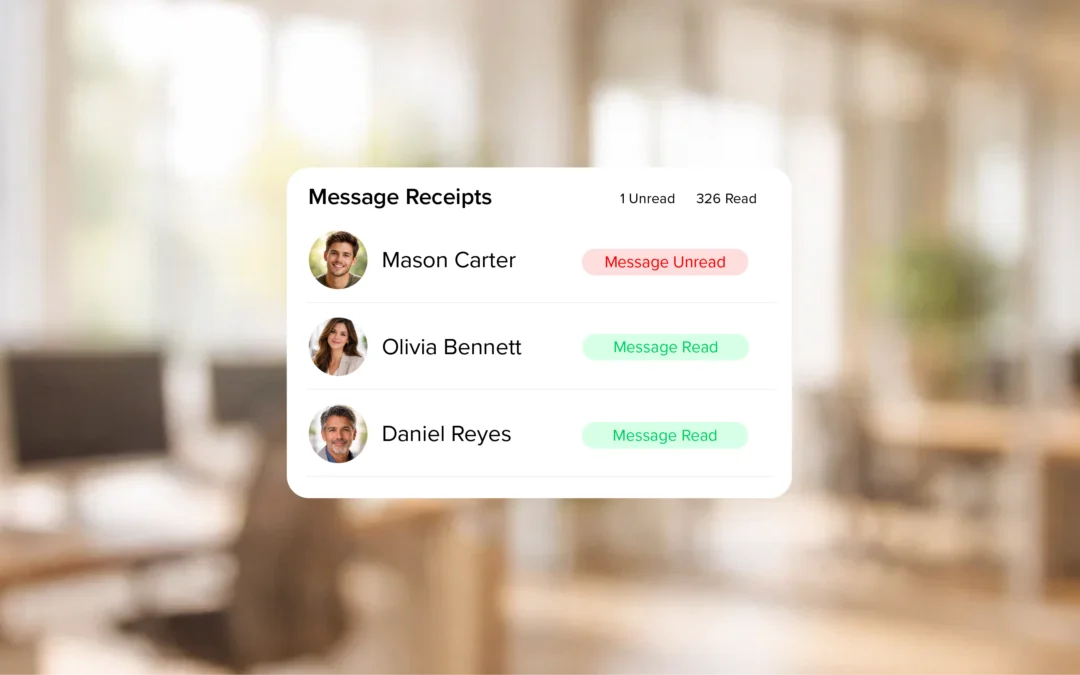
“Did you see my message?” If you’re a leader, you’ve said this more times than you can count (or probably want to admit). If you’re an employee, you’ve heard it, or worse, realized too late that you missed something important.
Asking for confirmation sounds harmless, but that one question reveals a much bigger problem lurking about most organizations: communication is everywhere…and nowhere at the same time.
Messages live in emails, texts, Slack channels, Teams threads, company meetings, LMS portals, whiteboards, and someone’s memory of “that thing we talked about last week.” And everyone is expected to keep up – perfectly.
Spoiler alert: they don’t.
The Real Cost of Scattered Communication
Poor communication is not only annoying for all parties involved, but also incredibly expensive. According to The Harris Poll, U.S. businesses lose $1.2 trillion each year due to ineffective communication.
Employees waste almost 8 hours every week just trying to find information, clarify expectations or redo work that shouldn’t have been wrong in the first place. That’s one full work day every week!
When communication breaks down, companies are tempted to solve the problem by adding more communication. More emails. More meetings. More reminders. More follow-ups. But somehow, things only get worse. Why?
Because sheer communication volume doesn’t fix fragmentation. When messages are scattered across platforms, leaders have no visibility into what was delivered, read, understood or acted on. “Did you see my message?” suddenly becomes:
“Can you confirm you got this?”
“Let me know once you’ve read it.”
“I’ll just repeat it in the meeting…again.”
Bad news: It’s exhausting. Good news: It’s entirely preventable.
Centralization Changes Everything
Centralized communication means one source of truth. One place employees go for updates, training and expectations. One system leaders trust.
Unlike email or chat tools, microlearning apps are designed for clarity, accountability and reinforcement. Leadership can not only send messages to everyone all at once, they can also see exactly who’s received what and when.
No more guessing and no more having to chase down folks. Brilliant.
Why Microlearning Works (And Long Messages Don’t)
The human brain is not wired for information dumps. Traditional communication methods assume people will read long emails (they won’t), remember details from meetings (they won’t) and recall training from months ago (you guessed it – they won’t).
Thanks to the “forgetting curve,” people forget 70% of new information within 24 hours and 90% of it within a week. It’s not a human defect; it’s simply biology. Our big beautiful brains are designed to prioritize efficiency, shedding information that’s not immediately put to use.
When employees try to read novelesque emails, their brains struggle to process and store all that information. Without reinforcement or immediate application, those hard-won messages are lost.
For organizations, this spells trouble. Time is money. Employees spend an average of 5.5 minutes drafting each email, totaling over 10 hours per week, yet only 1 in 3 messages are fully read. Why? Because 57% of recipients will not read an email if it is longer than 8 sentences.
Microlearning apps work with the brain, matching how people actually consume information. Short, repeatable bursts of content strengthen neural pathways, cementing information into long-term memory.
Email sports a dismal 18% open rate and is read on average 90 minutes after receipt. Unlike email, mobile alerts boast a 98% open rate and 90% are read within 3 minutes of receipt.
Microlearning apps like Tyfoom use the power of mobile alerts to significantly boost the success rate of company communication. Because readers typically lose focus after 8 seconds, in-app mobile alerts keep messages brief and within the optimal target range of 50 to 150 words.
The “In the Flow of Work” Advantage
Another reason company communication fails? Timing.
Most messages arrive when people are busy, distracted or already overwhelmed. Microlearning apps deliver communication in the flow of work, not on top of it. Employees consume updates when it fits naturally into their day. That alone dramatically improves engagement and response rates.
Speaking of engagement, it matters because communication doesn’t work if people don’t care. Gallup estimates disengaged employees cost companies 34% of their salary in lost productivity. That’s like setting $20k in cash on fire for every $60k employee you have. It does you just about as much good.
Microlearning apps boost engagement by turning communication into an experience, not a chore. With short video content, progress tracking, badges, recognition and friendly competition, employees see their progress. They build momentum. And feel, dare I say it, excited about coming to work.
When engagement goes up, messages get read, training gets completed and leaders stop wondering if anyone’s paying attention. Hallelujah!
Accountability Without Micromanaging
Most leaders don’t want to micromanage; they just don’t trust the system. When communication is scattered, leaders compensate by hovering, following up, repeating themselves and double-checking everything.
Managers already spend 14 hours per week on repetitive work, which creates a major productivity drain. That’s time they should be spending on strategy, growth and people. Microlearning apps restore trust by providing built-in accountability through automatic read receipts, completion tracking and engagement analytics.
No more awkward check-ins. No constant reminders. Just pure, refreshing, delicious visibility.
Doing More With Less Starts With Better Communication
In times of economic uncertainty, every business must find ways do more with less whether that’s leaner teams or tighter budgets. The organizations that succeed won’t work harder. Nope, they’ll be working smarter.
“Did you see my message?” isn’t a smart leadership strategy. Heck, it’s not even a leadership strategy!
But when communication is centralized, consistent and trackable, that question disappears. People know where to look. Leaders know what’s sticking and what needs more work. Teams stay aligned without endless follow-ups.
Yes, please.
Streamline your communication and reap the rewards by scheduling a meeting to speak with a Tyfoom training consultant today!