
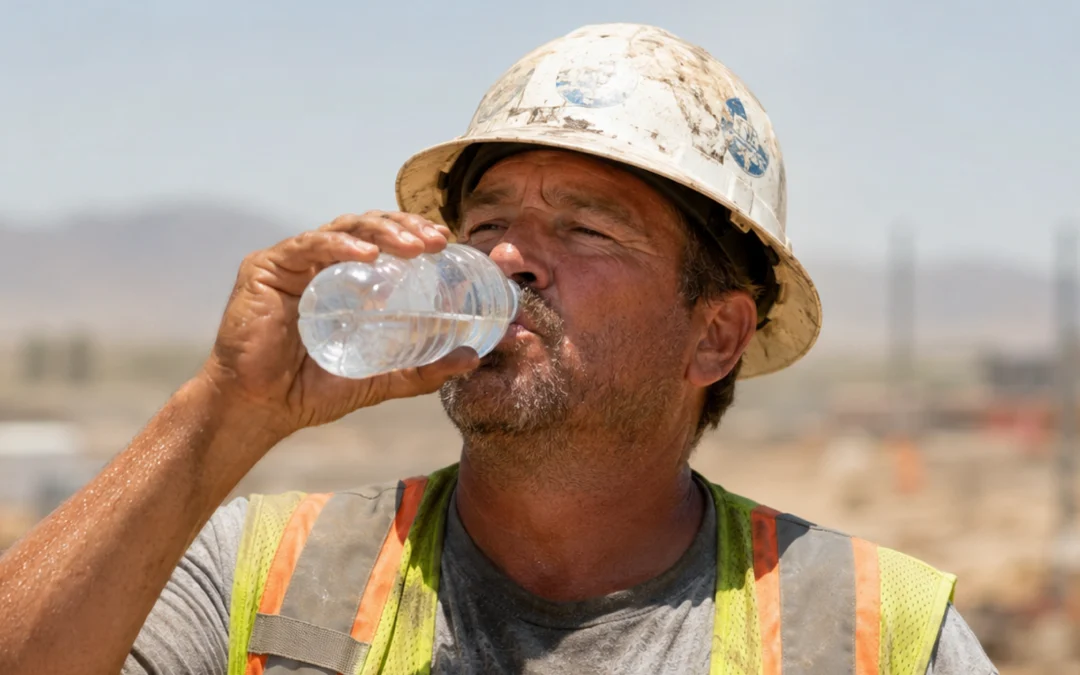
Heat safety – I know, I know, you’re tired of hearing about it.
It’s all over, everyone is talking about it. Standards, regulations and guidelines have been changing; everyone is modifying policies and procedures, and many are capitalizing on the supply of necessary controls.
But just like you heard your mom say “Remember your manners” hundreds of times to remind you to be respectful and polite, or “Were you born in a barn?” to remind you to close the door, or the infamous “Because I said so!” to remind you that, well, you just don’t argue with Mom.
It takes a lot of repetition for us to get good at things. Heat safety reminders are no different. Construction trades and the blue collar workforce are used to “working through it,” “gettin’ it done” and “rubbin’ some dirt on it.”
This has been the mindset and culture FOR-EVER.
But the reality is that just like working at heights, with electricity/energy, around heavy equipment or many other daily hazards could lead to a serious injury or workplace fatality, heat exposure poses a hazard that can cause serious injuries, illnesses and even fatalities – all of which can be prevented.
Heat-Related Incidents are Preventable
In 2024, the National Safety Council reported a total of 48 workplace fatalities across all industries related to Heat Exposure. Half of those were in the Construction Industry alone.
The NSC also reported 7,100 DART (days away, restricted or transferred) cases, including 5,280 DAFW (days away from work) cases in 2023 and 2024.
A workplace fatality typically costs a company around $1.5M. And averaging a semi-conservative $25 per hour, that’s about $1M – $1.5M in days away costs. According to OSHA, a single heat-related illness can cost a company around $79k. And on top of that, OSHA fines can reach around $200k per incident.
Investing in an improved education and training program regarding heat-related illnesses and injuries, modifying policies and procedures regarding working in hot environments, and investing in improved controls like systematic water supply, ventilation, shade, cooling methods, breaks, and other options will more than pay for itself.
Protect Your People with Heat Safety
But the cost is not the main concern. These are people. These are your people. Someone’s dad, mom, brother, sister, uncle, aunt, grandma, grandpa, cousin, friend. These are people’s lives being negatively impacted or lost by preventable workplace illnesses and injuries.
As a business, as a leader, it is your responsibility to ensure you are educating and training your people for the hazards they encounter in the workplace, and that they understand how to implement the proper controls available to “prevent” a workplace incident or injury.
Let me say that one word again: re-spon-si-bil-i-ty. It’s a regulation. It is the expectation, not an option. More importantly, it is a moral and ethical obligation you have to your people and their families. The ones who are doing the work. The ones who are growing your business. The ones who are making your company profitable.
As a leader and a business owner, you took on this responsibility, and it is yours to own, yours to follow through on, and yours to protect your people.
It is easy to get caught up in the pressure and the schedule. Everything is go, go, go. But when it comes to workplace hazards, when it comes to heat safety, it is always worth taking the time to invest in your people with effective policies, procedures and systems, training and communication, documentation and adequate tools, equipment and controls.
Here are some of the new requirements, guidelines and best practices to ensure your people that are exposed to heat-related illnesses in the workplace can better understand heat safety and follow through on proper controls.
Water, Rest, Shade
Hydration:
Ensure cool, potable drinking water is always accessible near the work area. Encourage workers to drink at least 1 cup (8 ounces) every 15 to 20 minutes.
Not all water is created equally. Ensure the water has essential minerals to support true hydration and avoid excessive use of “electrolyte” type sports drink powders that may be high in sugar. Too much of those can support dehydration. Avoid caffeine and alcohol, which also contribute to dehydration.
Rest Breaks:
Allow ample time for workers to recover from the heat. Increase the frequency and duration of breaks as the heat index climbs. Morning break and lunch break are not enough. Plan some strategic short breaks throughout the day based on your work schedule.
Shade and Cooling:
Provide designated shaded or air-conditioned areas for breaks. For outdoor sites, shade must be present when temperatures exceed 80°F. You might have some already natural “cool” spots in your facilities or on your projects.
Popping up tents, and sitting in air-conditioned vehicles for a few minutes throughout the day are game-changers for outdoor work with no shade in sight. I feel you civil contractors – been there, done that!
Other preventative measures and actions for an effective heat safety program include:
Acclimatization
Ease In Gradually:
Nearly 3/4 of heat-related fatalities occur during a worker’s first week on the job. New and returning employees require time to acclimatize physically.
The 20% Rule:
On Day One, work no more than 20% of the shift’s duration at full intensity in the heat. Increase the duration by no more than 20% daily until workers are fully adjusted.
Engineering and Administrative Controls
Weather Scheduling:
Schedule the most strenuous physical tasks for early mornings or the cooler parts of the day.
Engineering Interventions:
Make the physical environment safer by increasing ventilation, providing cooling fans, installing reflective shields or using mechanical equipment to reduce heavy manual labor.
Clothing:
Require lightweight, light-colored, and breathable fabrics while still adhering to required Personal Protective Equipment (PPE) standards.
Training and Supervision
Heat Safety Education:
Train supervisors and workers to identify the signs of heat stress (e.g., heavy sweating, dizziness, cramps) and outline first aid steps.
Buddy System:
Mandate that workers monitor themselves and verbally check on each other frequently.
Medical Emergencies and First Aid
Heat Illness Symptoms:
Early signs include heavy sweating, hot dry skin, nausea, weakness, and elevated body temperature.
Emergency Response:
If a worker shows symptoms of abnormal thinking, slurred speech, seizures, or loss of consciousness, call 9-1-1 immediately. Cool the worker right away with water or ice until help arrives.
Tyfoom Makes Heat Safety Easy
The Tyfoom mobile app and platform supports your efforts to prevent heat-related illnesses and injuries and improve your heat safety program. You can effectively execute this using Tyfoom by providing:
- Automated daily microlearning videos (with quizzes) on heat safety
- Alert messages for heat indexes and areas of concern with visibility of receipt
- Policies and procedures for your best practices in a couple of clicks
- Resources for your emergency actions and nearby support clinics
- Customizable digital forms to document controls in place for the core requirements, individual acclimatization tracking, pre-task plans, incident reporting and more
So while you might be tired of hearing about heat-related illness and injury info as you were of your mom saying, “How many times do I have to tell you?” Get together with your teams, including your front-line workers, and make sure you have all of the proper plans, training, and controls in place to prevent a heat-related illness or injury.
Why? “Because I said so.” 😉
Protect your people this summer by scheduling a meeting to speak with a Tyfoom training consultant today.
More information on heat safety can be found through OSHA, NIOSH, CDC, ANSI, NSC, ASSP, APHA, BLS, and WHO.