Your company spent months choosing an LMS. You sat through demos, compared features, migrated content, created courses, assigned users and launched the platform.
And then, after all that effort, people didn’t want to use the platform. Similar complaints, just as poor usage. Sound familiar?
It’s not your fault. It’s just how humans think and act.
Most employees will still log in to the LMS when there’s mandatory compliance training (especially after dozens of reminders). New hires will most often complete their assigned courses. And, reports can be pulled when somebody needs documentation. But voluntary logins? They rarely happen.
Training only creates value when people actually use it. A platform can house 10,000 beautifully designed courses with critical information that you’ve created, but if team members avoid opening them (or rush through them just to check a box) the organization isn’t getting much return on that investment.
People know they won’t remember most trainings because we are wired to naturally forget what isn’t consistently reinforced. Lasting learning comes from consistent reinforcement and communication, not a one-time training in an LMS. In other words, teams learn best from content when they explore it daily.
Traditional learning management systems are great at managing content. But learning management and daily learning through employee engagement are two very different things.
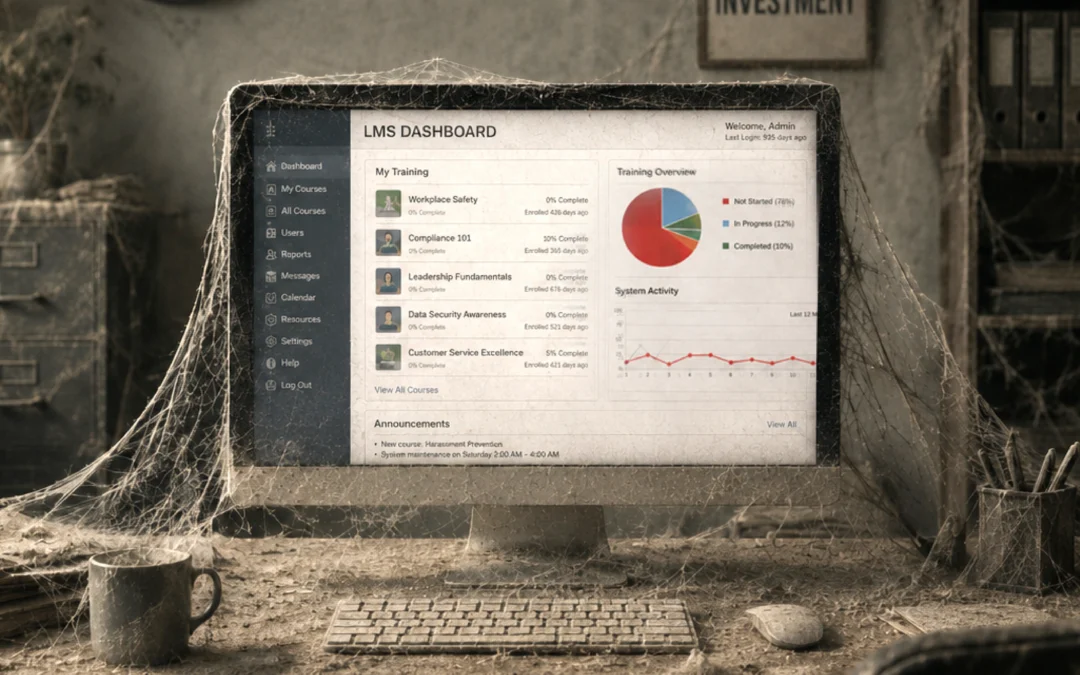
If your LMS is collecting digital dust, it may be time to rethink how training reaches them.
The LMS Was Built for a Different Workplace
The traditional LMS has dominated corporate learning for decades. In fact, approximately 98% of large companies use an LMS to deliver, track and manage e-learning materials.
There’s a reason these platforms became popular, specifically standardization of content at scale for compliance. Companies needed somewhere to organize training, have a consistent message, distribute courses, document completions and manage compliance. The LMS solved that administrative headache.
But the workplace changed. Today’s employees are mobile. They’re dispersed across offices, job sites, vehicles and plants. They work during travel. They’re accustomed to pulling a phone out of their pocket and finding an answer in seconds. They consume information through short videos and searchable content in apps, like TikTok and Instagram designed to be intuitive from the first tap.
Then they sit down and log into an LMS to complete a 45-minute course. Team members feel a disconnect when anything is longer than 120 seconds. This leads to feelings of “maybe my employer doesn’t understand me.” Again, not your fault. It’s human nature.
The question isn’t whether an LMS can technically deliver training. Of course it can. The better question is whether the way it delivers training encourages employee engagement. For many organizations, the answer is increasingly no. Here’s why:
Problem #1: Training Takes Too Long
Time is one of the biggest barriers to workplace learning. Teams already have jobs to do, and managers already feel pressure to produce more with fewer resources. Asking someone to do an hour-long course takes that hour away from something else.
Traditional LMS content also takes significant time to produce. Most LMS course designers spend an average of 48 hours creating a course. Based on an average instructional designer wage of $47.48 per hour, that course costs roughly $2,280 in labor before it’s even launched. Not to mention all the blood, sweat and tears that go into creating great content.
The traditional model essentially asks organizations to spend considerable time creating long-form content and then asks workers to spend considerable time consuming it. No wonder employee engagement and morale suffer.
Short-form, video-based microlearning takes a different approach. Rather than asking teams to carve out large blocks of time, learning can be delivered in one- to two-minute lessons that fit naturally into the workday.
Instructional designers can take great content and optimize learning paths more effectively to meet the needs of employees at the speed of business.
Problem #2: Too Much Information at Once
Longer training feels more substantial. It looks serious on a calendar and impressive in a course catalog – but that doesn’t necessarily mean it’s effective.
Thanks to the “Forgetting Curve,” people forget approximately 70% of new information within 24 hours and about 90% within a week. That’s a brutal statistic for any organization spending thousands (or hundreds of thousands) of dollars on employee development.
Traditional training often tries to teach everything at once because organizations have limited opportunities to get their people into the classroom or LMS. So they cram as much information as possible into the session.
It’s about as effective as sipping out of fire hose.
Instead of trying to make employees remember everything at once, daily microlearning uses bite-sized lessons and repetition to reinforce important concepts over time. As a result, learning becomes much less intimidating.
“Complete this two-minute lesson” is very different from “Complete this 60-minute course.” One fits into the workday and is relevant to the employee. The other competes for their time and disrupts the flow of work.
Problem #3: Completion Isn’t the Same as Performance
Training metrics can become misleading. For instance, your admin dashboard says 97% of your workforce completed the course. Fantastic. What did they learn? More importantly, what did they do differently afterward?
In one study, only 12% of employees reported applying new skills learned through LMS systems, while only one in four said LMS training measurably improved their performance.
Companies don’t invest in training because they want more check marks. They invest in training because they want teams to become better at their jobs.
An employee who simply completes training is not necessarily an employee who is learning. Participation has to go beyond clicking “Next” for it to have lasting, positive, long-term effects.
Problem #4: The LMS Waits for Employees to Come to It
Think about the apps you use every day. They don’t sit quietly in the corner of your screen hoping you remember they exist. They remind you, create habits, surface information and, most importantly, give you reasons to come back day after day.
Many traditional training systems operate differently. Team members receive an assignment, log in, complete it and leave. The next interaction may not happen until another course is assigned weeks or months later.
That’s not a habit: That’s an administrative transaction. Building employee engagement requires consistency. Daily microlearning allows organizations to create a predictable learning rhythm.
Workers receive short lessons regularly rather than massive courses occasionally. Push notifications trigger participation, while a simple mobile experience reduces the number of steps between the user and the end goal. Over time, training becomes less of an event and more of a habit, which is far more sustainable in the long-term.
Problem #5: Employees Can’t See Their Progress
Traditional LMS platforms tend to be very good at showing administrators what teams have completed. They’re not always as good at showing employees how they’re growing, which remains a huge missed opportunity.
People are motivated by progress. We like knowing we’re getting better. It’s why fitness apps track streaks, games display levels and language-learning apps celebrate milestones.
Modern learning platforms can bring those same principles into the workplace through badges, achievements, progress tracking, social rewards and friendly competition.
Tyfoom, for example, uses gamification to make learning progress visible. Individuals can track achievements, see past performance, earn badges and compare progress with others.
Training stops disappearing into a completed-course archive and gives learners an immediate reason to keep participating, boosting employee engagement.
Problem #6: Traditional Training Isn’t There When Employees Need It
Another weakness of traditional LMS learning is timing. Imagine an employee learns a particular process during onboarding. Eight months later, he finally encounters a situation where he needs to use it.
No one expects him to remember everything from the training nearly a year ago. But he will recognize it the next time he takes the training.
Traditional LMS training can keep track of who has completed what, but information often isn’t delivered at the point of need. Employees may have to navigate an entire course or search through previously completed courses just to find one piece of information.
Team members should be able to find answers to their questions in two clicks or less. With a searchable microlearning library, individuals can revisit short videos when they actually need the information.
Problem #7: The Cost Goes Far Beyond the Subscription
The LMS price tag isn’t limited to what appears on the invoice. Organizations pay an average of $826 to $1,700 per user per year depending on company size. Implementation can take 12 to 29 weeks, including learning the platform, uploading materials and teaching teams how to access training.
Then there are the hidden costs like course development, training time, administrative work, content updates and lost productivity.
The average U.S. company spends $1,071 on traditional training per employee each year. When workers don’t retain or apply that learning and change behavior, you get a serious ROI problem.
Don’t Replace Training. Replace the Training Experience.
Highly engaged teams can generate a 23% increase in profitability. Organizations with highly engaged people also experience 41% lower absenteeism and 59% less turnover.
Meanwhile, disengagement can cost an employer as much as 34% of an employee’s salary in lost productivity. For someone earning $60,000 annually, that’s a whopping $20,400 in lost value every year.
Training provides organizations with a recurring opportunity to strengthen that engagement. Done poorly, it becomes another annoying requirement team members endure. Done well, it can reinforce progress, development, connection and purpose.
Your people want to develop. They just don’t necessarily want to develop through the systems given to them.
Instead of relying solely on long-form courses, organizations can make learning shorter, visual, mobile, searchable and continuous. Daily video-based microlearning reinforces concepts over time, while gamification creates visible progress and on-demand libraries give team members answers when they need them.
Learn how you can use employee engagement to your advantage by scheduling a meeting to speak with a Tyfoom training consultant today.